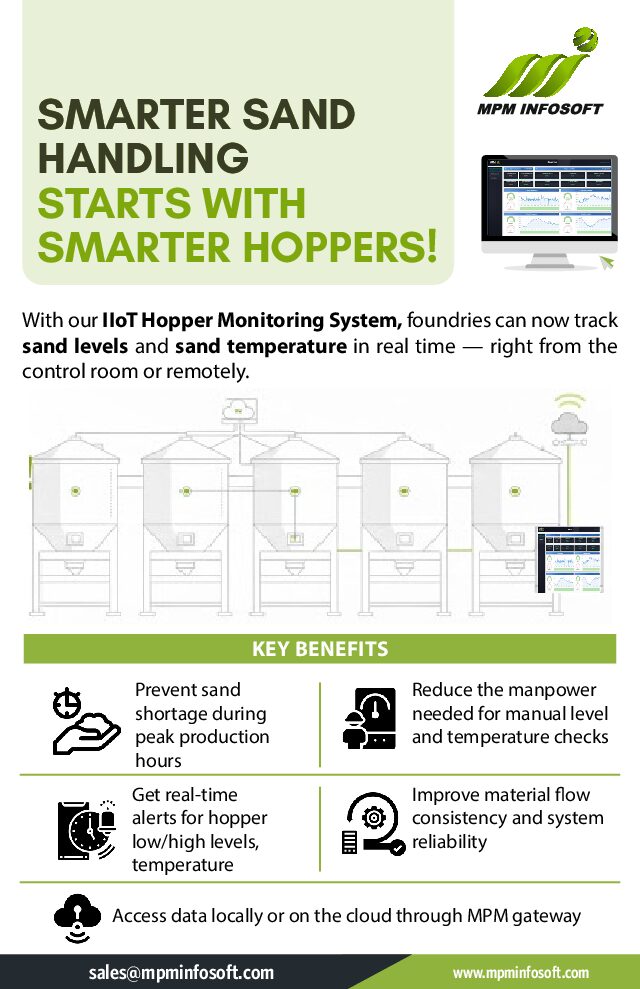
Smart Hopper Monitoring System

Green Sand: Art to Analytics

The Smart Hopper Monitoring System replaces manual hopper checks with continuous, real-time level tracking, using a radar level sensor, an IoT gateway, and automated relay control to keep material flow steady and downtime low.
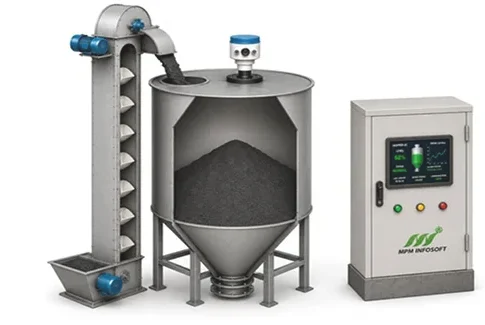
Smart Hopper Image

Overview

Foundries and bulk material handling operations often still monitor hopper levels manually, walking the floor to check by eye or feel. Without real-time visibility, operators can’t tell how much material remains until a hopper runs low or overflows, and problems stay invisible until they interrupt production.

The Smart Hopper Monitoring System replaces that guesswork with continuous, non-contact radar level sensing. Data flows through an analog acquisition module and an IoT gateway to a live dashboard, with relay-controlled automation keeping hoppers within safe fill limits without constant operator attention.

Traditional Hopper Monitoring Creates Costly Downtime

Challenges
  • Manual inspection of hopper levels
  • No real-time monitoring of material quantity
  • Unexpected hopper empty conditions
  • Delayed replenishment
  • Excess filling
  • No centralized monitoring
  • Lack of access to historical data
Solution
  • Continuous, non-contact radar level sensing removes the need for physical checks
  • A live dashboard displays real-time hopper levels fed by the IoT gateway
  • A configurable low-level threshold automatically starts the bucket elevator before the hopper runs dry
  • Relay action mapping and automatic reset conditions trigger refilling without waiting on manual observation
  • A configurable high-level threshold automatically stops the bucket elevator to prevent overfill
  • A single dashboard shows main hopper and mixer hopper status together
  • Historical data logging plots hopper level trends over time

How the System Works

The Smart Hopper Monitoring System combines a radar level sensor, an analog acquisition module, an IoT gateway, and a relay output module to control a bucket elevator automatically.

  1. A radar level sensor measures hopper fill level continuously and sends a 4 to 20 mA analog signal
  2. An analog acquisition module reads that signal and passes it to the IoT gateway over Modbus RTU (RS485)
  3. The IoT gateway processes the data, displays it on its dashboard, and sends control signals to the relay output module
  4. The relay output module starts or stops the bucket elevator based on high-level and low-level thresholds: high level stops the elevator, low level starts it

Level Sensor

Rocksensor Radar RLT6900L, Lens Antenna

  • Continuous, non-contact level measurement for bulk solids in dusty environments
  • Uses 80 GHz FMCW radar for level measurement
  • Resolution: 1 mm
  • Accuracy: plus or minus 5 mm
  • Range: up to 120 m
  • Protection rating: IP67
  • Lens antenna generates a focused radar beam
  • Swivelling antenna holder allows optimized sensor alignment
  • Air purge provision maintains reliable measurement under dusty conditions
  • Isolated transmit and receive signals enable full-range measurement with minimal dead zone

IoT Gateway (With Integrated HMI)

Primary features:

  • 10.1-inch industrial HMI based on the Raspberry Pi CM4 platform
  • 12 to 24V DC supply, 2 USB 2.0 ports, digital I/O
  • Cloud connectivity through WiFi, 4G LTE, and Ethernet
  • Industrial communication interfaces, including Modbus serial (RS485) and Ethernet

Key functions:

  • Displays real-time hopper levels
  • Processes sensor and relay logic
  • Logs process data locally
  • Supports remote monitoring and configuration

Dashboard

Key features:

  • Configurable upper and lower thresholds
  • Relay action mapping
  • Automatic reset conditions
  • Real-time hopper visualization with live level indication
  • Configurable hopper dimensions

The dashboard splits into a Configuration UI, where thresholds and relay actions are set, and a Visualization view, showing hopper diagrams, current fill levels, process min and max ranges, high and low limits, and live bucket elevator status for both the main hopper and the mixer hopper.

Historical Data

The system logs a real-time hopper level trend for each hopper, plotting material level against time with high-level (HL) and low-level (LL) threshold lines clearly marked, so operators can review fill and drain patterns over time rather than relying on memory or spot checks.

Why It Matters

Intelligent Automated Level Control:

  • Continuous monitoring
  • Real-time visibility
  • Automatic material handling
  • Reduced downtime
  • Scalable architecture

Downloads for Smart Hopper

Available documents:
Hopper.pdf

Smart Hopper

File Type: PDF

Document: Product Brochures

Information - English - 11-08-2026 - 2.35 MB

PDF
Product-Brochure.pdf

MPM Product Brochure

File Type: PDF

Document: Product Brochures

Information - English - 07-07-2026 - 52.72 MB

PDF

Ready to Automate Your Hopper Monitoring?

Ready to Automate Your Hopper Monitoring?