

Most bentonite manufacturers in India sell on mesh size and swelling index alone, leaving foundries to guess whether a grade will actually hold their target Green Compression Strength (GCS) once it hits their specific sand-to-metal ratio. That gap between a spec sheet and real sand system performance is where most grade-selection mistakes happen, and it is expensive to fix after a production run is already underway.
MPM built this guide to remove that guesswork. It walks a foundry buyer through matching their sand system’s GCS target, swelling index, Methylene Blue (MB) value, and moisture profile against the right grade, so the decision is based on test data instead of a spec sheet alone, before a single bag is ordered.
Key Takeaways
- GCS target should drive grade selection first; swelling index and MB value are supporting evidence, not the starting point.
- A high swelling index does not automatically mean better binding performance if your sand system’s moisture window can’t absorb it.
- Foundries on automated, high-pressure molding lines with standard casting configurations generally fit a bentonite-plus-carbon pre-blend better than foundries with frequent pattern changes.
- MB value tells you how much active clay is actually working in your system, which matters more than total clay percentage when comparing grades.
- Grade switching should be validated against your own sand test data, not a supplier’s general spec sheet, since sand-to-metal ratio and return sand quality change how any grade performs.
What MPM Brings to This Decision
| Field | Detail |
|---|---|
| Core Capability | Matches bentonite grade selection to a foundry’s GCS, swelling index, MB value, and moisture targets |
| Product Lines | MPM BOND (conventional sodium bentonite), PROBOND (processed, higher-bond variant), Sandiron (bentonite and lustrous carbon pre-blend) |
| Technical Backing | Green Sand Interactive consultancy, sand testing benchmarking against MPM’s own reference data |
| Serving Area | Foundries across India, with export-quality grades available |
Start With Your GCS Target, Not the Spec Sheet
Green Compression Strength (GCS) is the mold’s resistance to crushing in its green, uncured state, and it is the single number that determines whether a casting holds its shape and dimensional accuracy during pouring. GCS is measured using standardized AFS rammed-sand specimen protocols, alongside separate tests for compactability and moisture that together give a full picture of the sand system.
The mistake most foundries make is comparing bentonite grades on swelling index or mesh fineness before confirming which grade actually delivers their required GCS at their current sand-to-metal ratio. A grade with an impressive swelling index on paper can still underperform if your return sand carries more dead clay than the grade was tested against.
Quick Comparison: MPM Bentonite and Pre-Blend Grades
| Grade | Type | Swelling Index | MB Value | Best Fit |
|---|---|---|---|---|
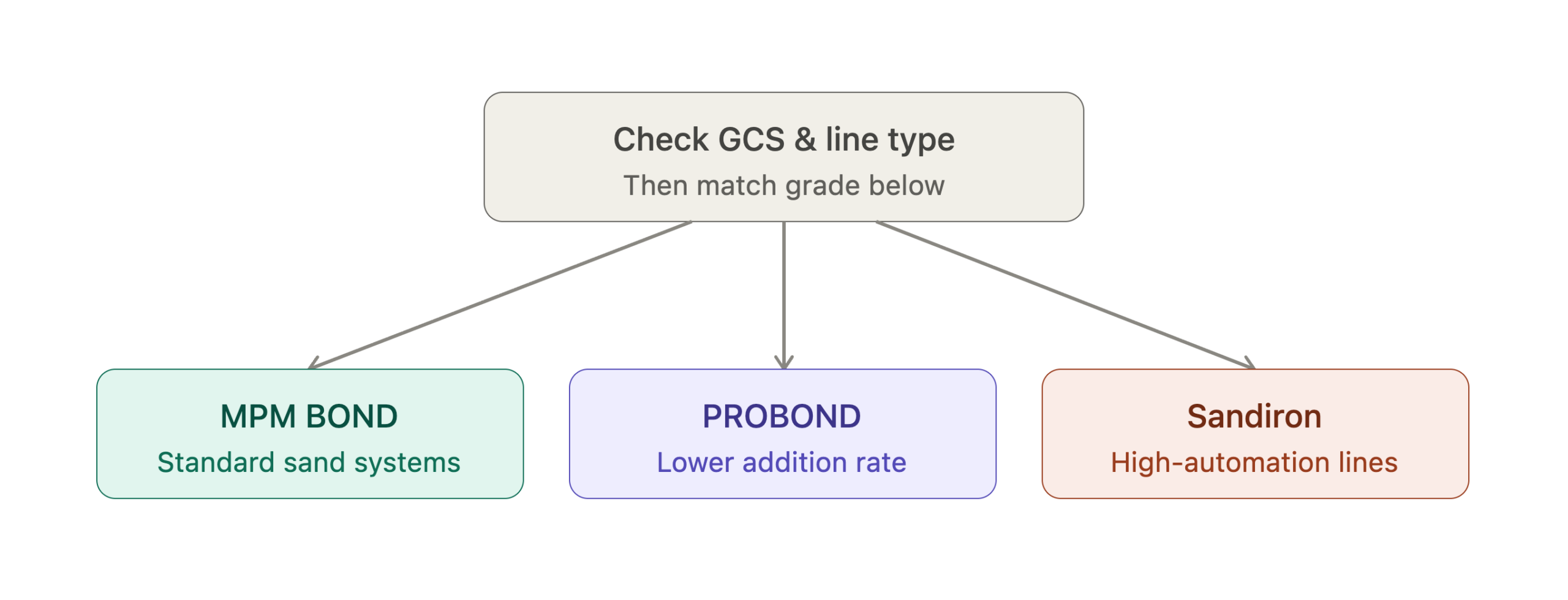
| MPM BOND | Conventional sodium bentonite | 30-35 ml per 2 gm | 420 ml | Standard green sand systems needing a reliable, general-purpose binder |
| PROBOND | Processed, enhanced-bond bentonite | Shorter swell and gel time than MPM BOND | Higher effective bond per unit dosage | Foundries needing to hit the same GCS target at lower bentonite addition rates |
| Sandiron | Bentonite plus lustrous carbon pre-blend | Not applicable as a standalone bentonite | Not applicable as a standalone bentonite | Automated, high-pressure molding lines running standard casting configurations |
MPM BOND: The Conventional Baseline
MPM BOND is a sodium-activated bentonite sourced from Kutch, Gujarat, carrying a Swelling Index of 30 to 35 ml per 2 gm and an MB Value of 420 ml on MPM’s general export quality specification. Its Gelling Formation Index sits at 70 percent, with swelling described as instantaneous.
When MPM BOND is the right starting point:
- Your sand system runs a conventional (non-automated) molding line without a tight moisture window.
- You need a general-purpose binder without paying for enhanced processing you don’t need.
- Your current rejection rate is acceptable and you are not chasing a lower bentonite addition rate.
PROBOND: When the Same GCS Needs Less Bentonite
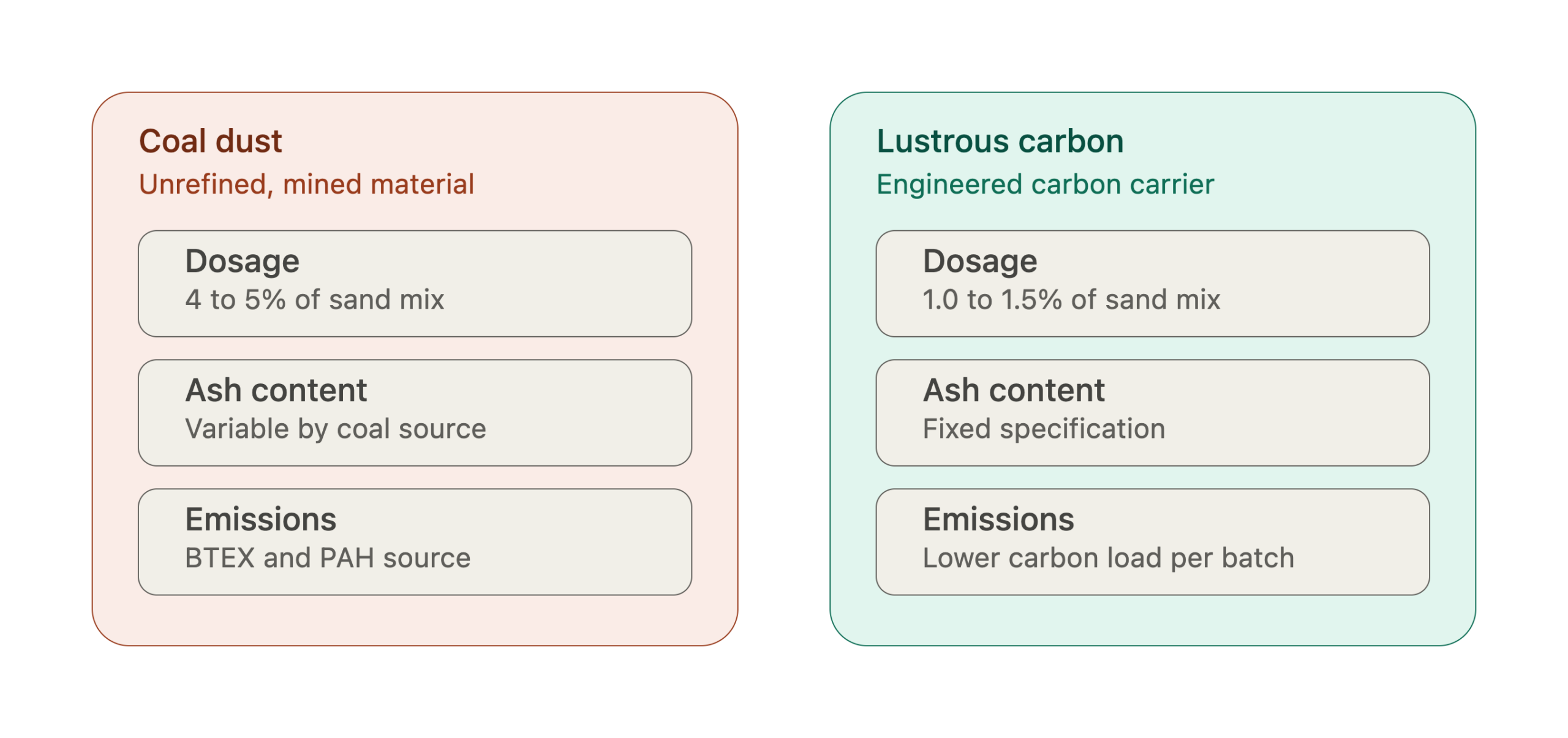
PROBOND is MPM BOND processed further to shorten swell and gel time and enhance bond capability, so a foundry can reach the same target GCS at a lower addition rate than conventional bentonite requires. That lower addition rate has a second effect: it improves sand flowability and permeability, reduces dead clay buildup, and maintains sand refractoriness over more circulations.
Diagnostic checklist for whether PROBOND fits your system:
- Check your current bentonite addition rate against your target GCS. If you are adding more bentonite than your casting grade should require, PROBOND’s higher bond-per-unit performance is the relevant lever.
- Review permeability trends over the last several return sand cycles. A downward trend often points to dead clay accumulation that a higher-bond grade addresses more efficiently than simply adding more conventional bentonite.
- Confirm your gelling and swell time requirements. If your molding line’s cycle time is tight, PROBOND’s shorter swell and gel time is a direct operational fit.
Exact numeric specifications for PROBOND should be confirmed directly with MPM’s technical team, since the grade is positioned as a processed enhancement over MPM BOND rather than a separately published spec sheet.
Sandiron: When the Line, Not the Bentonite, Is the Deciding Factor
Sandiron is not a bentonite grade in the traditional sense. It is a pre-blend combining high-quality bentonite with lustrous-carbon-producing additives, dosed as a single measure instead of two separate additions. That single-shot format is specifically suited to foundries running near-standard casting configurations and consistent sand-to-metal ratios on highly automated molding lines and sand plants.
Where Sandiron fits, and where it doesn’t:
- Fits well where pattern changes are infrequent and casting configuration stays consistent, since the pre-blend ratio is fixed at the point of manufacture.
- Requires closer monitoring where pattern changes are frequent, since a single dose additive can’t be independently rebalanced between the bentonite and carbon components mid-batch the way two separate additions can.
- Delivers high green compression strength, good peel of sand, and anti-scabbing performance in one dose, which reduces the operator judgment calls a two-additive system requires.
Reading Your Own Test Data Correctly
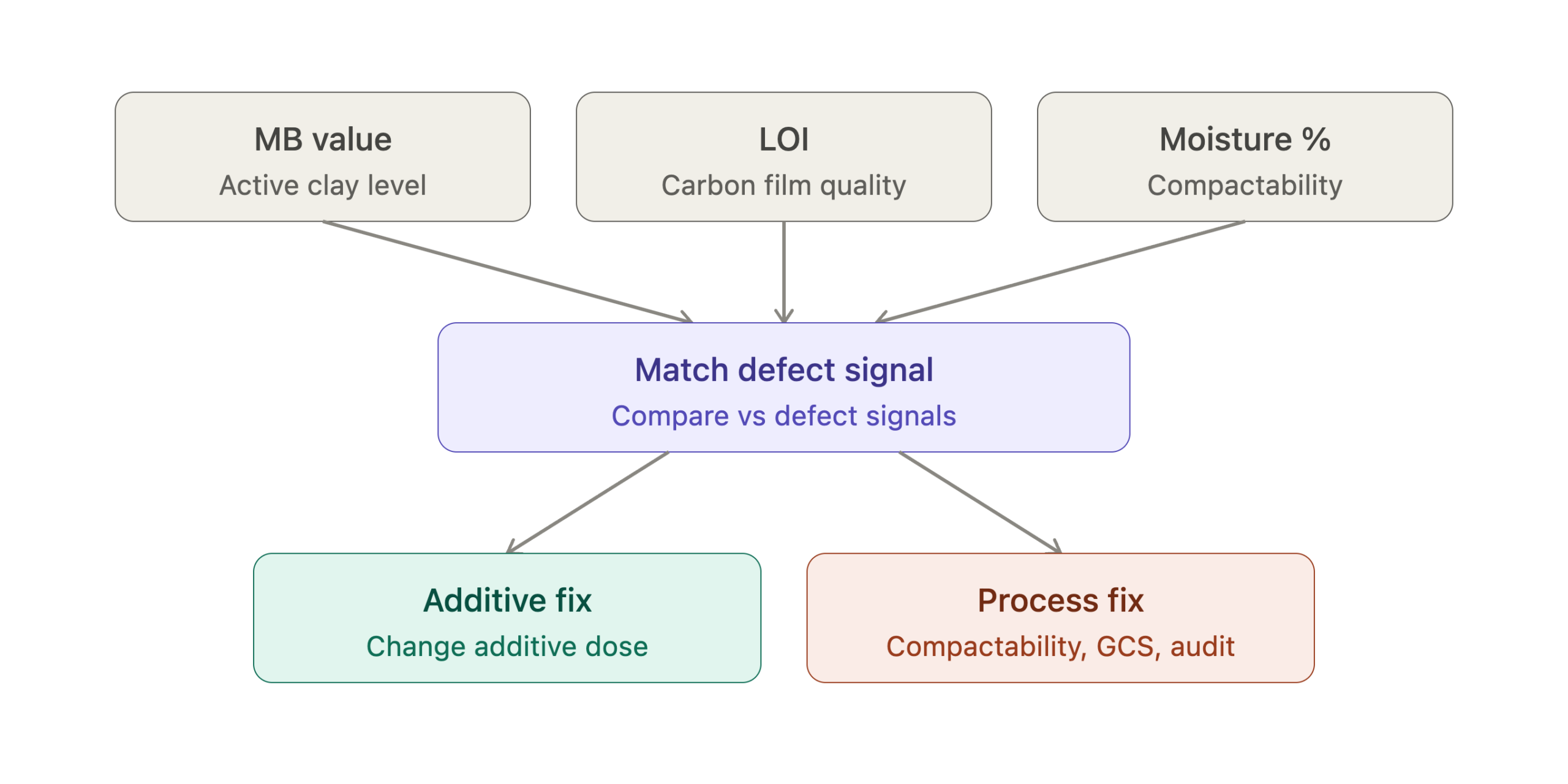
Methylene Blue (MB) value and swelling index tell two different stories, and confusing them is where most grade-selection mistakes start. The Methylene Blue clay test measures active clay through titration, meaning it captures only the working bentonite in your system, not the total clay content that includes dead or spent clay left over from prior circulations. Swelling index, by contrast, is a property test run on the fresh bentonite itself, independent of what has already happened in your sand loop.
Why this distinction matters for grade selection:
A grade can pass every fresh-material swelling index check and still underperform in your actual sand system if your MB value shows the active clay contribution is lower than expected once combined with your return sand. Modern Casting’s guide to interpreting green sand test numbers recommends testing MB clay content on a regular weekly schedule alongside other core sand properties, precisely because these figures shift independently of each other as a sand system circulates.
Moisture is the variable that connects both numbers back to GCS:
- Moisture below the optimal window under-hydrates the clay, so even a high-MB-value system won’t reach its rated GCS.
- Moisture above the optimal window can lower green strength and increase blowhole risk, masking the bentonite grade’s true binding potential.
- Foundries switching grades should re-run their moisture-to-GCS curve rather than assuming the new grade behaves identically to the old one at the same water addition.
Putting the Selection Together
Start with your GCS target and your molding line type, since those two facts eliminate options faster than any spec sheet comparison. From there, MB value and swelling index tell you whether your current grade, or a candidate grade, can realistically hit that target once your actual return sand and moisture profile are factored in. Foundries without an internal lab can use MPM’s Green Sand Interactive service to benchmark their current sand test results against MPM’s own reference data before committing to a grade switch.
Frequently Asked Questions (FAQs)
MPM BOND is MPM’s conventional sodium bentonite from Kutch, Gujarat. PROBOND is that same bentonite processed further to shorten swell and gel time and increase bond capability, allowing a foundry to reach the same GCS target at a lower addition rate.
A higher swelling index alone doesn’t guarantee better performance. Check your GCS test results against your target first. If GCS is falling short despite adequate moisture, a higher-bond grade like PROBOND is a more direct fix than simply switching to a higher swelling index product.
Not exactly. Sandiron is a pre-blend combining bentonite with lustrous carbon additives in one dose, best suited to automated molding lines running consistent casting configurations. Foundries with frequent pattern changes typically get more control from separate bentonite and carbon additions.
Methylene Blue value measures the active, working clay in your sand system through a titration test, distinguishing live binder from dead or spent clay left over from previous circulations. It is a better indicator of real binding capacity than total clay percentage.
Not reliably. Each grade has its own moisture-to-GCS relationship. Switching grades without re-testing your moisture window against the new grade’s performance can mask whether the new grade is actually a better fit.