

Coal dust built the green sand foundry industry, but it also built its emissions problem and its inconsistency problem. Lustrous carbon additives like Lustron and Lustronite were engineered specifically to fix both, without asking a foundry to change its equipment or process. This guide compares the two head to head on surface finish, emissions, and batch-to-batch consistency, so a purchasing or technical lead can decide which one actually belongs in their sand system.
This lustrous carbon vs coal dust comparison focuses on the differences that matter most to foundries, including dosage, casting quality, emissions, and long-term operating costs.
Key Takeaways
- Coal dust and engineered lustrous carbon additives both work by forming a reducing gas layer at the mold-metal interface, but they differ sharply in how consistently they do it.
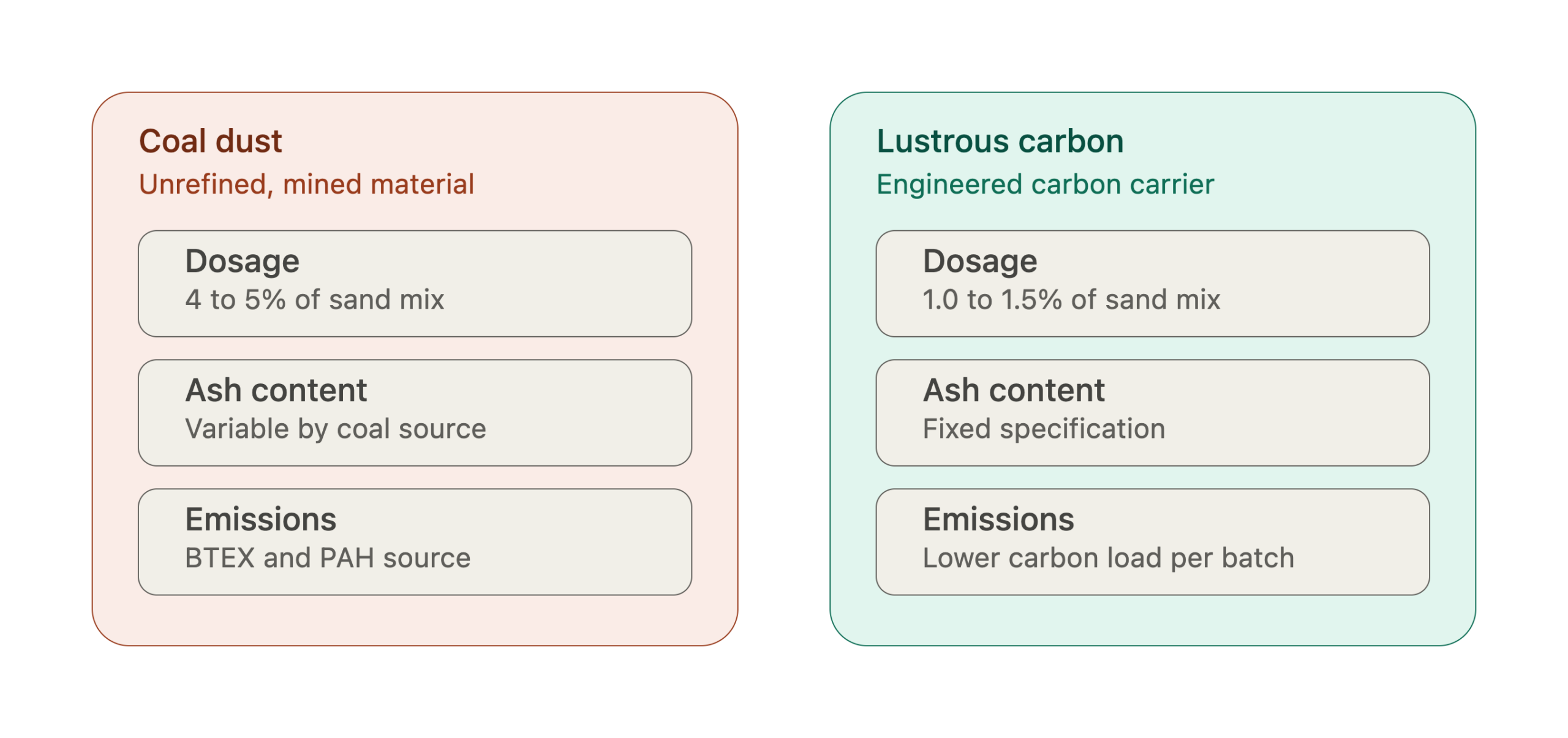
- Raw coal dust is typically dosed at 4 to 5 percent of the sand mix, while refined lustrous carbon carriers can achieve the same protective effect at roughly 1.0 to 1.5 percent.
- Coal dust combustion is a documented source of BTEX and PAH emissions in green sand foundries, a fact the industry has been working to reduce since the 1990 Clean Air Act.
- Engineered additives carry a fixed Ash Content specification batch to batch; raw coal dust’s ash content varies by mine source and grade, which is where most “unexplained” surface finish problems come from.
- Switching additive class does not require new equipment. The decision is a sand system and cost one, not a capital one.
Why This Comparison Matters Right Now
Smaller Indian foundries still treat coal dust as the default, low-cost choice, and in raw material cost per kilogram, it often is. But raw material cost per kilogram is the wrong number to compare. The right number is cost per good casting, and that number depends on rejection rate, rework labor, and emissions compliance, not just what the additive costs at the gate.
Looking at lustrous carbon vs coal dust from a total production cost perspective gives foundries a much clearer basis for selecting the right green sand additive than comparing material price alone.
Quick Comparison: Lustrous Carbon Additives vs. Coal Dust
| Factor | Coal Dust | Engineered Lustrous Carbon Additive |
|---|---|---|
| Typical dosage | 4 to 5 percent of sand mix | 1.0 to 1.5 percent of sand mix |
| Ash content | Variable, depends on coal source and grade | Fixed specification, engineered per grade |
| Surface finish consistency | Varies with coal batch quality | Consistent batch to batch |
| Emissions profile | Documented source of BTEX and PAH compounds | Lower carbon load per batch reduces total emission volume |
| Anti-scabbing chemistry | Not present; relies on carbon film alone | Built into the additive formulation |
| Process change required | None | None |
What Coal Dust Actually Does in a Green Sand Mold
When molten metal hits coal dust in the mold, the coal combusts and forms a reducing atmosphere that keeps the metal from oxidizing and bonding directly with sand grains. This same combustion is what creates the lustrous carbon film responsible for a clean casting surface. The mechanism works. The problem is what else that combustion produces.
Coal dust’s side effects, confirmed by industry sources:
- Volatile organic compounds and hazardous air pollutants (HAPs) are released during pyrolysis of the carbonaceous material, a well-documented finding tracked by the American Foundry Society’s own trade publication since at least 2019.
- Benzene is consistently the predominant BTEX compound measured in green sand molding emissions, according to a 2025 peer-reviewed emissions study across multiple binder systems.
- Ash content is inherently variable because coal dust is a mined, unrefined material, not a manufactured one.
- Higher dosage requirements mean more raw material handling, more dust exposure on the shop floor, and more spent material moving through return sand.
Where Engineered Lustrous Carbon Additives Differ
An engineered additive like Lustron is not raw coal dust with a new label. It is a purpose-built blend of selected carbonaceous material combined with anti-scabbing agents, manufactured to a fixed specification instead of whatever a given coal seam happens to produce.
Diagnostic checklist for deciding if your foundry needs to switch:
- Pull your current additive’s Ash Content and Volatile Matter (VM) readings across the last five batches. If they swing by more than a percentage point or two, that variability is coming from the raw material itself, not your process.
- Check whether surface finish complaints correlate with a specific coal dust delivery or supplier batch. If they do, you have a raw-material consistency problem, not a dosage problem.
- Review your current dosage rate against the 4 to 5 percent typical for coal dust. If you are already at the high end and still seeing scabbing or burn-on, more coal dust will not fix it.
- Ask your EHS team whether BTEX or particulate monitoring has flagged the molding line. If it has, an additive switch is a compliance lever, not just a quality one.
Lustron is manufactured across three defined grades, Lustron-F, Lustron-Premium, and Lustron-HPL, each with a fixed Ash Content specification between 3.5 and 5 percent. That fixed ceiling is the direct opposite of what a foundry gets from raw coal dust, where ash content depends on where the coal was mined and how it was processed before it reached the plant.
Surface Finish: Where the Real Difference Shows Up
Surface finish inconsistency is usually the first thing a foundry notices when its coal dust supply quality drifts. Foundry research on lustrous carbon carriers going back decades has consistently found that refined carbon carriers achieve the same or better lustrous carbon film at a fraction of the dosage coal dust requires, largely because the refining process controls particle size and carbon purity that raw coal dust cannot.
For foundries running standard configuration castings on automated molding lines, this consistency matters more than the per-kilogram price difference. A pre-blend such as Lustronite is built for exactly this case: tailor-made carbon carrier chemistry aimed at surface finish, without the batch-to-batch guesswork that comes from an unrefined material.
Emissions: The Comparison Most Foundries Underweight
Emissions compliance is becoming a harder constraint, not a softer one. Workplace dust exposure rules and air quality monitoring requirements are both tightening, and coal dust combustion is the specific mechanism generating BTEX and PAH emissions inside the mold cavity, not just a general foundry emissions issue.
Because engineered lustrous carbon additives typically run at a quarter to a third of coal dust’s dosage rate for an equivalent protective effect, the absolute mass of carbonaceous material combusting inside each mold drops correspondingly. Less material combusting means less volatile compound generation per casting, even before accounting for any difference in the chemistry of the carbon source itself.
Consistency and Dosing: The Operational Case
In many foundries, coal dust dosing decisions are still made by feel, adjusted when a shift supervisor notices a problem. That works until it doesn’t, and when it doesn’t, the foundry is troubleshooting a defect instead of preventing one.
What a fixed-specification additive changes operationally:
- Dosage becomes a number you set and verify, not a judgment call re-made every shift.
- Ash Content and VM stay inside a known band, so LOI testing tells you about your process, not about which coal delivery arrived last week.
- New operators can be trained against a spec sheet instead of years of shop-floor intuition.
Foundries evaluating this switch without an internal lab can use MPM’s Green Sand Interactive service to benchmark current sand test results against MPM’s own reference data before committing to a change.
When Coal Dust Might Still Make Sense
This is not a case for eliminating coal dust in every foundry overnight. Foundries running very high sand-to-metal ratios with a stable, single coal supplier and no emissions pressure in their region may see limited practical upside from switching immediately. The honest comparison point is that coal dust’s low unit cost only stays low if its variability never causes a rejection, and for most foundries running mixed casting grades, that assumption does not hold for long.
Ultimately, the lustrous carbon vs coal dust decision should be based on overall casting performance, process consistency, emissions requirements, and total cost per good casting rather than purchase price alone.
Frequently Asked Questions (FAQs)
No. Lustrous carbon is the protective carbon film formed during combustion, not a raw material itself. Coal dust is one traditional, unrefined source used to produce that film. Engineered additives like Lustron are purpose-built carbon carriers designed to produce the same film more consistently and at a lower dosage.
Cost per kilogram and long-standing habit. Coal dust is cheap and foundries know how to handle it. The comparison foundries often skip is cost per good casting, which accounts for rejection rate and rework, not just raw material price.
No. Both are dosed through the same mixer and sand preparation process a foundry already uses. The switch is a formulation change, not a capital investment.
Coal dust is typically dosed at 4 to 5 percent of the sand mix. Refined lustrous carbon carriers can achieve a comparable protective effect at roughly 1.0 to 1.5 percent, though the exact figure depends on the casting grade and sand system.
Coal dust combustion in the mold is a documented source of BTEX compounds, including benzene, and polycyclic aromatic hydrocarbons. Lower dosage carbon carriers reduce the total mass of material combusting per casting.
Yes. Compare Ash Content and Volatile Matter readings across several coal dust deliveries. Significant swings between batches point to raw material variability rather than a process or equipment issue.