

Every green sand foundry loses money to the same five defects: scabbing, sand fusion, blowholes, veining, and metal penetration. Most rejection reports stop at naming the defect. MPM built this guide to go one step further. It diagnoses green sand casting defects and prescribes the additive class that fixes each one, so a QC lead can move from a rejected casting to a corrective action in one sitting instead of a week of trial batches.
Key Takeaways
- Scabbing, sand fusion, and blowholes almost always trace back to one of three variables: active clay content, moisture control, or lustrous carbon film thickness.
- Testing Methylene Blue (MB) Value and Loss on Ignition (LOI) before changing an additive dose prevents most guesswork-driven over-corrections.
- Veining and metal penetration are thermal expansion problems, not binder problems, and need a different fix than scabbing does.
- Compactability drift at the mixer is a leading, under-diagnosed cause of blowholes and metal penetration in shift-to-shift rejection spikes.
- A defect-to-additive map only works if it is checked against real sand test data, not applied as a blanket fix across every casting grade.
How to Read a Defect Before You Reach for an Additive
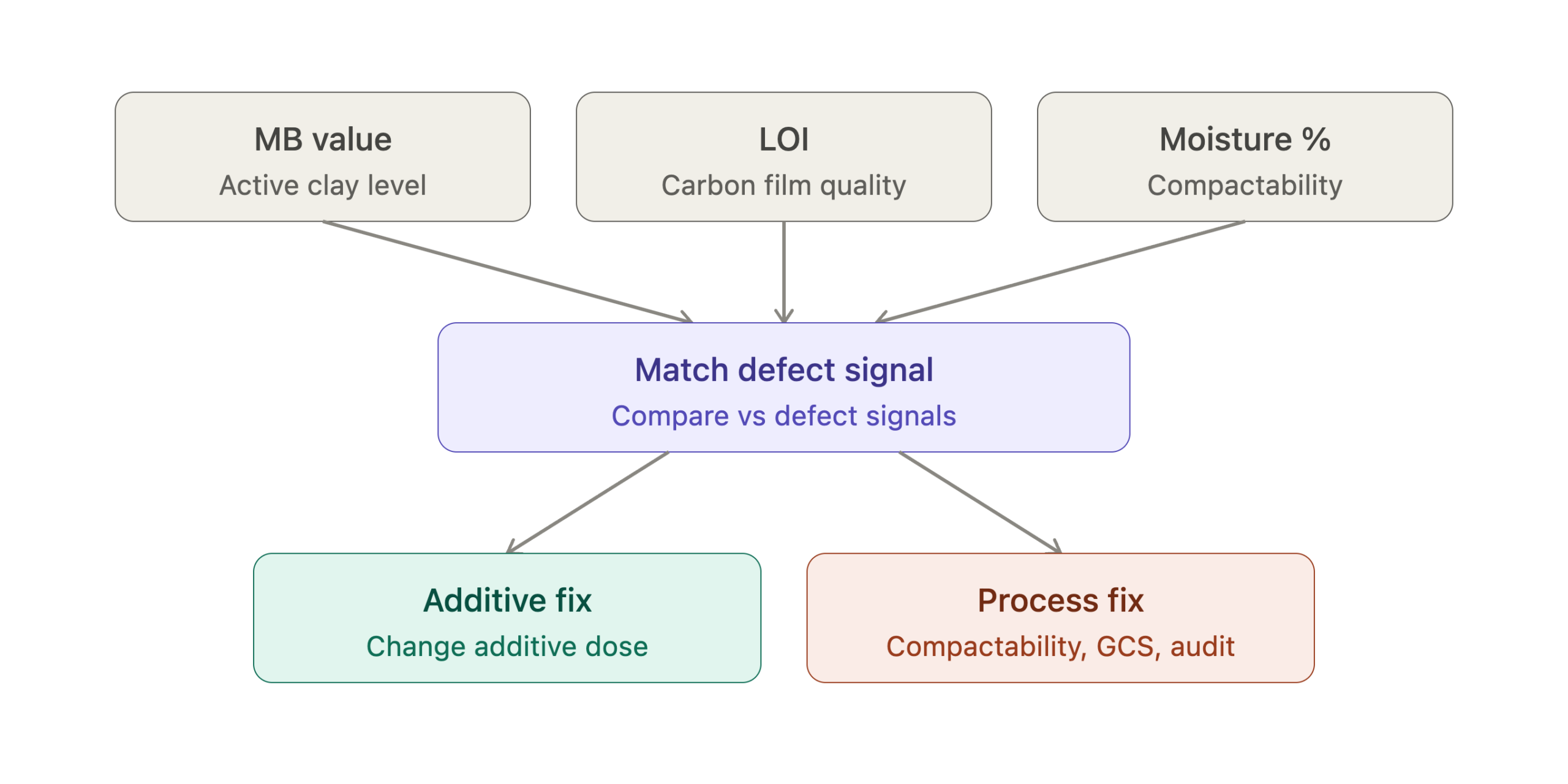
Before ordering a new drum of bentonite or lustrous carbon, pull three numbers from the lab: Methylene Blue (MB) Value, Loss on Ignition (LOI), and moisture percentage. Methylene Blue (MB) Value measures how much active, working clay is actually present in the sand system, distinct from total clay, which includes dead or spent clay that no longer contributes strength. Loss on Ignition (LOI) is the percentage of sand that burns off at high temperature, a rough proxy for how much carbonaceous additive is present and available to form a protective gas film against the metal.
Most defect diagnoses fail at this step. A foundry sees a scab, assumes the additive is under-dosed, and adds more bentonite without checking whether the real problem is moisture drift at the mixer or a drop in active clay from a return sand imbalance. The stakes are real at scale: metalcasting is a $51 billion industry in the US alone, and nearly 90 percent of durable goods contain at least one casting, so a defect pattern that goes undiagnosed for a full production run compounds fast. The table below is the fast triage; the sections after it explain each defect in depth. It will help you understand green sand casting defects in more depth.
Quick-Reference: Defect, Cause, and Additive Class
| Defect | Most Common Root Cause | Diagnostic Signal | Additive Class Needed |
|---|---|---|---|
| Scabbing / rat-tails | Low active clay, poor thermal expansion control, uneven ramming | Low MB Value relative to spec; scabs concentrated on cope (top) surfaces | Lustrous carbon additive with anti-scabbing agents |
| Sand fusion / burn-on | Insufficient lustrous carbon film, coarse sand grain, high pouring temperature | Low LOI; fused crust firmly bonded to casting surface | High Volatile Matter (VM) lustrous carbon additive |
| Blowholes / pinholes | Excess moisture, poor mold venting, low permeability | Moisture above 4 to 4.5 percent; round or oval cavities under the surface | Moisture and compactability control, not just additive dosing |
| Veining | Thermal cracking of core or mold surface, high sand expansion | Fine, sharp fin-like intrusions, often on cores | High-durability bentonite blend that resists thermal expansion cracking |
| Metal penetration | Coarse sand grain, high pouring temperature, low mold wash coverage | Rough, sandy texture bonded into the casting surface | High Green Compression Strength (GCS) bentonite plus mold coating |
Scabbing and Rat-Tails: Cause, Diagnostic Signal, and Fix
Scabbing shows up as raised, irregular metallic crusts on the casting surface, most often on the cope side of the mold where the sand is under the greatest thermal load. Scabbing is closely tied to the mold’s collapsibility and expansion behavior under heat, not simply to how much binder is present. That distinction matters for diagnosis of green sand casting defects: a foundry running high active clay but poor thermal control will still scab.
Diagnostic checklist for scabbing:
- Pull an MB Value test and compare it against your grade’s target range, not last month’s average.
- Check whether scabs cluster on cope surfaces or highly compacted sections; both point to expansion-related scabbing rather than simple binder shortage.
- Review ramming uniformity at the molding machine; uneven compaction concentrates stress in the same zones scabbing appears.
- Confirm the lustrous carbon additive’s Volatile Matter (VM) spec is still within range; a degraded VM signature reduces the gas-film cushion that normally absorbs expansion stress.
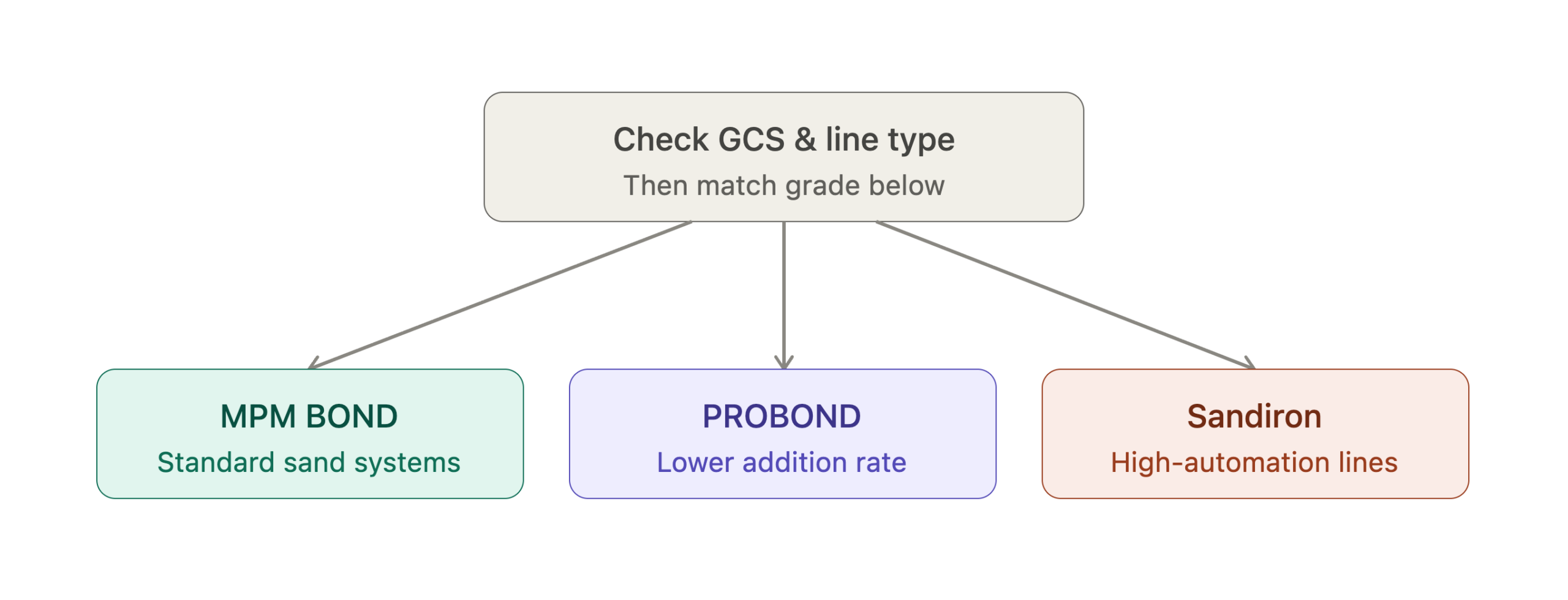
Foundries running MPM’s Lustron lustrous carbon additive address this by pairing anti-scabbing agents with a carbon film engineered to smooth thermal expansion at the mold face, rather than only adding bulk binder. Where scabbing is paired with weak mold strength, MPM’s Sandiron pre-blend restores Green Compression Strength (GCS) in a single shot, since it combines high-quality bentonite with lustrous-carbon-producing additives to address both needs at once.
Sand Fusion and Burn-On: Cause, Diagnostic Signal, and Fix
Sand fusion happens when the lustrous carbon film breaks down before it can shield the mold face, letting molten metal fuse directly onto sand grains. The result is a hard, adhered crust that usually requires grinding or shot blasting to remove, adding labor cost on top of the material loss.
The fastest diagnostic signal is a Loss on Ignition (LOI) reading below the grade’s target band. LOI approximates how much combustible carbon material is present and able to vaporize into a protective gas cushion at the mold-metal interface. A low LOI reading, paired with visible fusion, almost always means the carbon additive dose or its Volatile Matter (VM) quality has dropped, not that the bentonite needs adjusting.
Diagnostic checklist for sand fusion:
- Test LOI against the casting grade’s specification; do not compare across grades with different sand-to-metal ratios.
- Check sand grain size distribution; coarser grain increases surface area for metal penetration and fusion risk.
- Review pouring temperature logs for the affected heats; even a well-dosed additive cannot compensate for consistently high pouring temperatures.
- Confirm return sand is not diluting the active carbon percentage faster than fresh additive is replacing it.
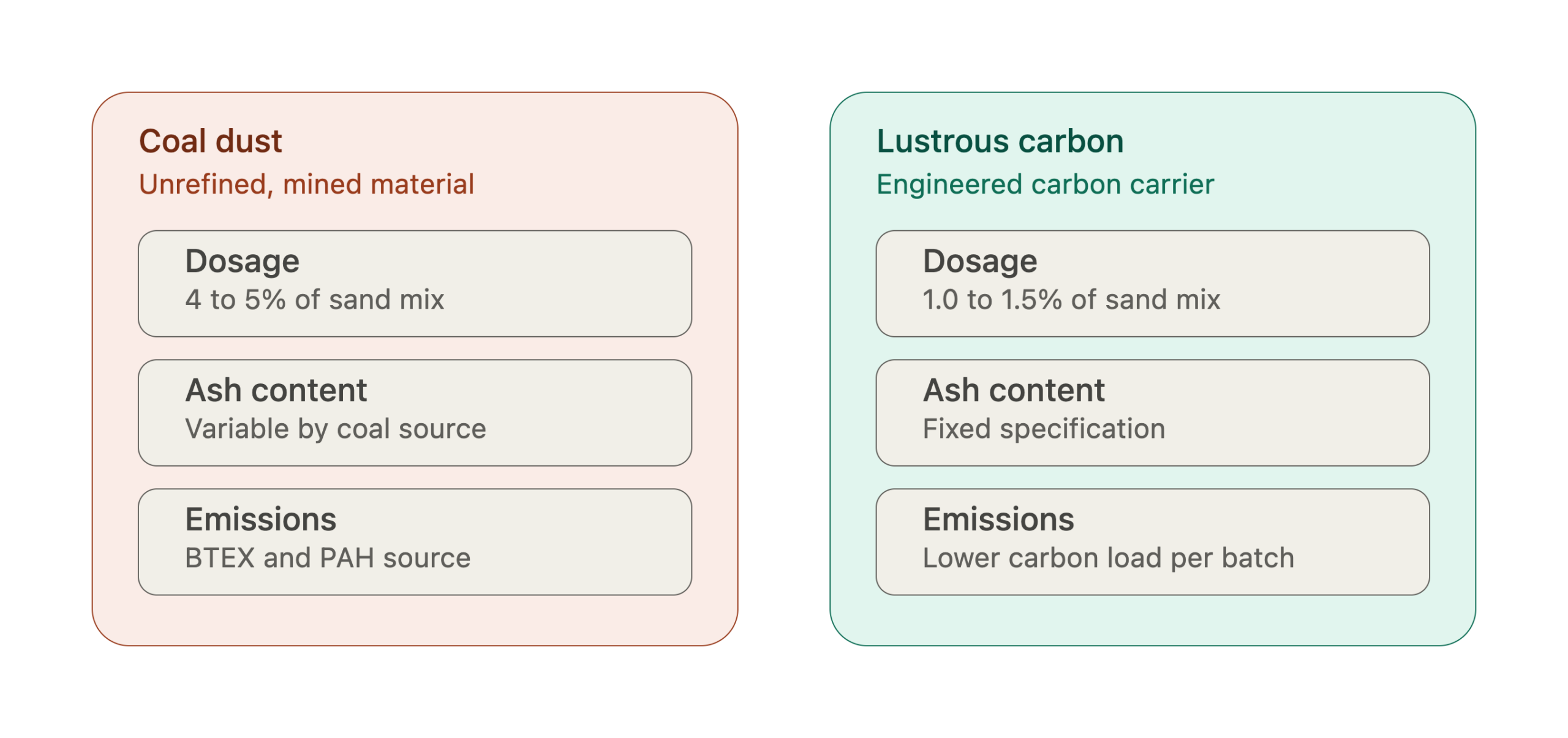
This is the exact failure pattern MPM’s Lustronite carbonaceous additive is built to address, giving foundries a tailor-made lustrous carbon option engineered specifically for surface finish and fusion resistance when a standard Lustron grade is not matching the sand system’s demands. These products can help address green sand casting defects and increase the efficiency of the foundry process.
Blowholes and Pinholes: Cause, Diagnostic Signal, and Fix
Blowholes and pinholes are gas defects, round or oval cavities formed when trapped air, steam, or combustion gases cannot escape the sand fast enough during pouring. Blowholes measure 3 millimeters or larger; pinholes stay under that threshold. In one documented Indian foundry case study, blowholes accounted for roughly 21 percent of total rejections, second only to sand drop defects at about 35 percent, making this category worth diagnosing carefully rather than treating as routine scrap.
Diagnostic checklist for blowholes:
- Check moisture percentage against the optimal 2 to 4 percent range for your sand system; excess moisture is the single most common blowhole driver.
- Confirm mold venting is adequate and not blocked by over-compaction.
- Review permeability test results; low permeability traps gas that would otherwise escape safely.
- Track compactability set-point drift at the mixer across shifts; a set-point that has not been adjusted for weeks, despite changing ambient humidity, is a leading and frequently missed cause of shift-to-shift blowhole spikes.
This is where additive chemistry alone will not solve the problem. MPM’s Green Sand Interactive service addresses the root cause directly through benchmarked sand testing and consultancy from a team with over 15 years of green sand laboratory experience, rather than leaving compactability drift to infrequent manual correction.
Veining: Cause, Diagnostic Signal, and Fix
Veining occurs when molten metal enters fine cracks that form on the core or mold surface as silica sand expands under heat. Left unaddressed, veining can progress into full metal penetration. Cores made with phenolic-urethane cold-box binders are more prone to veining than hot box or shell-process cores, due to their higher packing density and lower hot strength.
Diagnostic checklist for veining:
- Inspect whether veins appear primarily on core sections; this points to core sand expansion rather than mold-body sand.
- Compare veining severity against known high-risk binder systems in use on the affected line.
- Check for any recent increase in pouring temperature or holding time, both of which intensify thermal expansion stress.
The correct additive class here is a high-durability bentonite blend that resists cracking under thermal load, rather than a straight increase in lustrous carbon, since veining is fundamentally a sand expansion issue rather than a gas-film issue.
Metal Penetration: Cause, Diagnostic Signal, and Fix
Metal penetration occurs when molten metal pushes between individual sand grains or chemically bonds to the sand surface, leaving a rough, gritty texture that is difficult and costly to clean. It shares causes with sand fusion but tends to run deeper into the mold surface, and is strongly associated with coarse sand grain size, high pouring temperatures, and insufficient mold wash coverage.
Diagnostic checklist for metal penetration:
- Review sand grain fineness; coarse grain increases the void space metal can penetrate.
- Confirm mold or core coating coverage is even and at spec thickness, particularly on high-pressure areas of the mold.
- Cross-check pouring temperature against the casting grade’s upper limit.
- Test Green Compression Strength (GCS); low GCS allows metal to force its way between grains under pressure.
Foundries usually need two things at once here: a bentonite blend engineered for higher GCS, and a mold coating layer suited to the casting’s metal type and section thickness. Contact MPM’s technical team to schedule an on-site process audit that confirms which of the two is the binding constraint before committing to a product change.
Key Sand Properties to Test Before You Order a New Additive
- Loss on Ignition (LOI): the percentage of sand that burns off at high temperature, used as a working proxy for how much active carbonaceous additive is present and able to form a protective film during pouring.
- Methylene Blue (MB) Value: a measure of active, working clay content in the sand system, distinguishing live binder from spent or dead clay that no longer contributes to mold strength.
- Green Compression Strength (GCS): the mold’s resistance to crushing in its green, uncured state, a direct indicator of how well it will resist metal penetration and dimensional distortion.
- Volatile Matter (VM): the percentage of a lustrous carbon additive that vaporizes under heat to form the gas-film cushion that protects the mold face from fusion and scabbing.
- Swelling Index: a measure of how much a bentonite expands on contact with water, used to judge its binding and thermal-durability performance before it goes into the sand system.
Wikipedia’s overview of casting defects is a useful, vendor-neutral starting reference for understanding how these five defect types are classified across the wider metalcasting industry, alongside the American Foundry Society’s glossary of metalcasting terms, which defines these properties in the same terms foundry engineers use on the shop floor. For a sense of where your own numbers stand, an internal scrap rate under 4 percent is generally considered a fair benchmark across the industry, though foundries continue to push toward zero.
Putting the Diagnosis Together
The five defects (such as green sand casting defects) in this guide almost always trace back to one of three variables: active clay content, moisture and compactability control, or lustrous carbon film quality. Test before you dose. A scab or a blowhole can look identical from one shift to the next while having a completely different root cause, and the additive that fixes one will do nothing for the other. Pull the MB Value, LOI, and moisture readings first, match the defect against the table earlier in this guide, and only then decide whether the fix is a different additive, a mixer set-point change, or a process audit. That order, test first and dose second, is what separates a one-time fix from a repeat rejection problem.
Frequently Asked Questions (FAQs)
Scabbing is caused by low active clay content and poor thermal expansion control at the mold face. Testing MB Value first, then switching to a lustrous carbon additive with anti-scabbing agents, resolves most cases without a full sand system rebuild.
Both are gas defects caused by trapped air or steam. Blowholes measure 3 millimeters or larger; pinholes stay under that size. Both point to excess moisture or poor mold venting rather than an additive shortage.
Check Loss on Ignition first. A low LOI reading usually means the lustrous carbon dose or its Volatile Matter quality has dropped. Restoring VM through a fresh, correctly dosed lustrous carbon additive is the direct fix.
No. Veining is metal entering fine surface cracks caused by sand expansion, most common on cores. Left uncorrected, it can progress into true metal penetration, where metal pushes between individual sand grains instead of just surface cracks.
Moisture percentage and compactability at the mixer, checked against the shift’s ambient temperature and humidity. Compactability drift is a frequently missed cause of sudden, shift-to-shift rejection spikes.
Sometimes, when a single-shot pre-blend addresses both binder strength and surface finish together. It is not a substitute for testing which specific property, MB Value, LOI, or moisture, is actually out of range.
At minimum, once per shift on any line running mixed casting grades or a high sand-to-metal ratio. GCS drift is a leading, underreported cause of both metal penetration and dimensional inaccuracy.
MPM’s technical team can schedule an on-site or lab-based sand system audit before you change additive dosing.